2026 Research Cycle
Contribute to Bangladesh's Largest Reproductive Health Index (2026).
Your responses feed the evidence district health officers use when they argue their annual budgets. Registration takes under a minute, the survey itself about twelve, and every completed response is de-identified before it reaches the analysis team.
Why it matters
What the index measures, and who reads it.
The Reproductive Health Index is a repeat household survey run each year since 2018. It records access to antenatal and postnatal care, distance to the nearest functioning facility, contraceptive choice and refusal, out-of-pocket costs, and the reasons women give for delaying or abandoning care. Because the same districts are surveyed year after year, the dataset shows change over time rather than a single snapshot.
The findings are used by district health officers preparing annual budget submissions, by researchers at partner universities, and by our own field teams when deciding where to send the mobile camps next. Where a district's numbers move, we can say what moved and when.
The questionnaire takes about twelve minutes. Direct identifiers — your name, email and phone number — are used only to send you the link and are separated from your answers before analysis begins. We cannot promise absolute anonymity, because we do hold your contact details until you ask us to delete them; what we can promise is that your answers are not published or shared in a form that names you.
What you get, and what we ask
- A single official survey link, sent by both email and WhatsApp.
- The published district summary for your area when the 2026 cycle closes.
- An answer to any question you send to the research team before you begin.
- We ask for about twelve minutes, and honest answers rather than complete ones — every question can be skipped.
- We ask that you register once only, so district counts stay accurate.
0 participants have verified their details and received their survey link.
Questions before you register?
Write to research@srijonifoundation.org or message the research team on WhatsApp. Nobody is added to the survey list by asking a question.
Request your official survey link
We send the link by both email and WhatsApp so it reaches you whichever you check first.
Your data
What happens to your answers.
Three stages, described as plainly as we can. If anything here is unclear, ask before you register rather than after.
1. Collected
You answer a hosted Google Form, or an enumerator records your answers on a tablet during a household visit. The form asks about access to care, cost, distance and household circumstances. Every question can be skipped, and you can close the form at any point — a partial response is still useful to us.
The contact details you give on this page are held in a separate list, used to send the link and a single reminder, and nothing else.
2. De-identified and stored
Before analysis, direct identifiers — name, email, phone — are stripped from the response file and replaced with a random participant code. Answers are stored at district level; we do not publish village or union-level breakdowns where the group is small enough to make someone identifiable.
Access to the linked file is restricted to the research lead and the data manager. No system is beyond compromise, so we hold as little identifying information as the work allows, and for as short a time.
3. Published and returned
Findings are published as district summaries and an annual report, and are shared with district health offices, partner clinics and collaborating universities. Aggregate tables are released openly; the underlying response file is not.
To withdraw consent or ask for your record to be deleted, email research@srijonifoundation.org with the address you registered with. We will confirm deletion in writing. Responses already included in a published aggregate cannot be pulled back out of it.
Partner with us
Three ways organisations and individuals work alongside us.
Each of these is a working relationship with obligations on both sides. We would rather set them out now than discover the mismatch during a camp week.
Local NGOs and community organisations
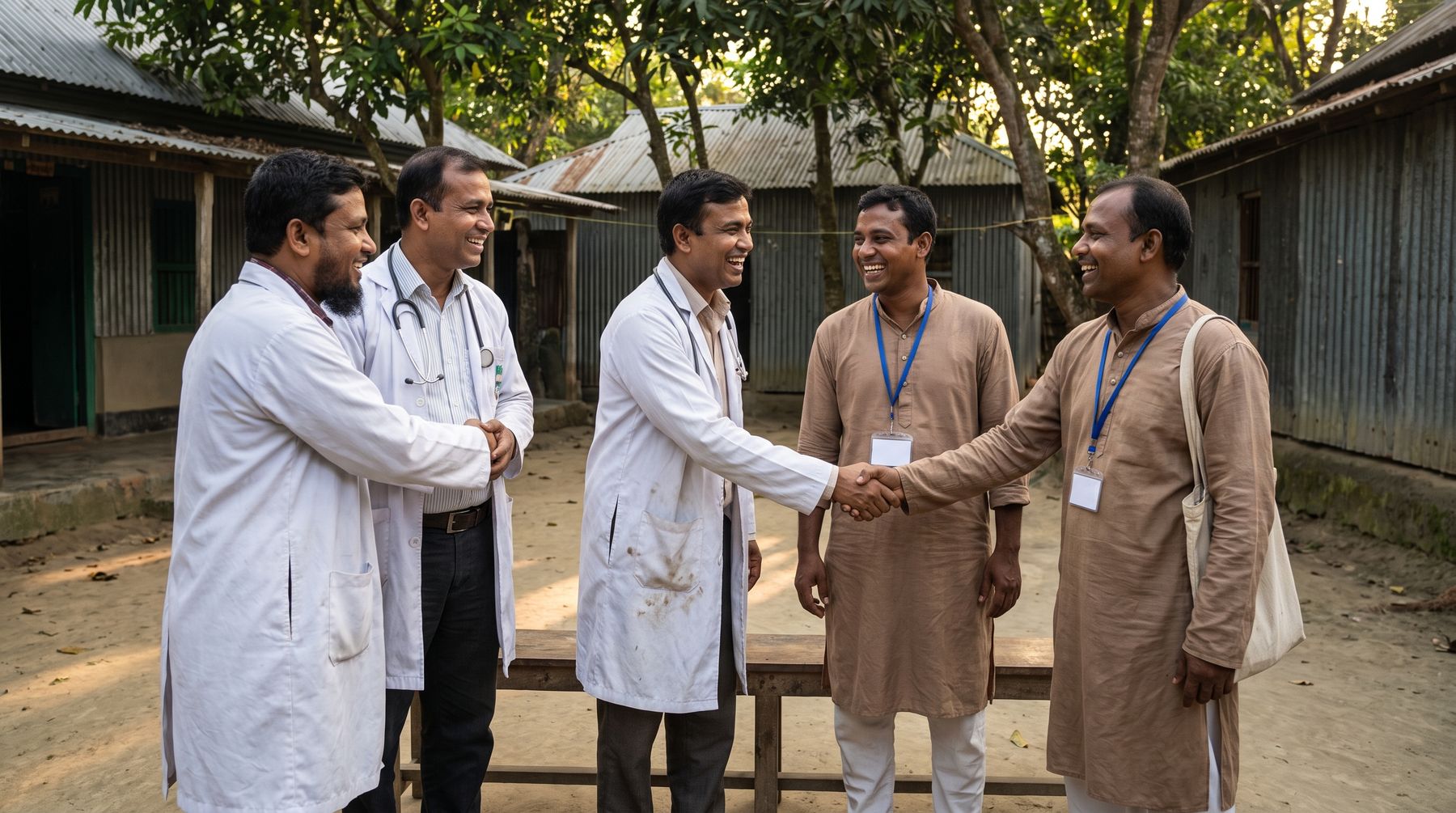
You get joint camp scheduling across your catchment area, shared enumerator training, and co-credit on any district summary drawn from work we run together. We ask for a named coordinator, community mobilisation ahead of camp dates, and agreement to our safeguarding and data-handling protocol.
Doctors and clinics
You get membership of the referral network, rotation slots on the mobile camps, and first sight of the district findings for your area. We ask for a minimum of two camp days a year, current registration with the BMDC, and referral notes returned within a fortnight so the loop actually closes.
Volunteers
You get a place on an enumerator training cohort, or work in translation and data entry, with a written reference on completion. We ask for a full training weekend, Bangla and English literacy for translation roles, and a signed confidentiality undertaking before you see any response data.
Support the work
What a contribution pays for.
We describe giving as units of work rather than as donor tiers, so you can see what is being bought.
A camp day
One mobile clinic day in a rural upazila: van and fuel, a female clinician and two health workers, consumables, and the referral notes that follow patients back to a district facility.
A counselling caseload
A month of Apon Jononi helpline capacity: counsellor hours, supervision, and onward referral to a partner lawyer where a caller needs one.
A school cohort
A full Uddipona term for one class of adolescent girls: facilitator, printed workbooks, and the teacher briefing that keeps the material running after we leave.