We are recruiting interns for the current cycle. See the open roles

Careers & Internships

Applied sociology, learned in the field.

An internship here is a working placement on a live programme: you clean and code real survey data, travel with the field teams to the districts they cover, and see the finished analysis go out to the district health offices that use it.

Why join us

You will do the work, not watch it being done.

Srijoni is a small organisation, which means interns are given real tasks on live programmes rather than a parallel project invented for them. Across a placement you will touch three things at once: applied sociology, in the design and coding of survey instruments; public health research, in the data those instruments return from the mobile camps; and grassroots NGO management, in the scheduling, consent-taking and district relationships that make fieldwork possible at all.

Every intern is assigned a named supervisor inside the programme they join, and meets fortnightly with them. Study designs, sampling decisions and draft outputs are reviewed by the research advisors who sign off our instruments before they go to field, so the methods feedback you receive is the same feedback the programme itself receives.

Fieldwork costs are met by the Foundation and are never deducted from anything else: inter-district travel, accommodation on overnight field stays, and a per diem for days spent away from home. A stipend is paid for the duration of the placement. The internship is a fixed-term placement and does not carry an offer of employment at the end of it.

What you leave with

  • A named research output. Your contribution is recorded on the district summary, transcript set or cleaned dataset you worked on. Authorship on any published paper is decided separately by the research advisors on the usual academic criteria, and is not part of the internship offer.
  • Field experience. Time in the districts your cycle covers, working alongside the enumerators and camp teams rather than observing them.
  • Methods training. Structured induction in sampling, consent-taking, interviewing and de-identification, completed before you are given access to any response data.
  • A written reference. A signed reference from your supervisor on completion, describing what you actually did and what you were responsible for.
Five young Bangladeshi professionals with laptops standing outside a modern Dhaka office building at golden hour

Open roles

Three internships, open now.

Each entry below sets out what the work actually is, what we require, and how much of your week it takes. Read the commitment line before you apply — it is the part applicants most often underestimate.

Most of this role is the unglamorous half of research, done properly. A typical week is spent cleaning survey returns — reconciling duplicate household records, chasing enumerators about implausible entries, and coding open-text answers against the codebook. Alongside that you transcribe recorded interviews and translate them from Bangla into English, keeping the Bangla original beside your translation so a reviewer can check it. Toward the end of a cycle you run descriptive statistics on the cleaned file and draft the tables that go into the district summary.

You will be shown the de-identification protocol during induction and will work on files that have already had direct identifiers removed. Nothing you handle leaves the Foundation's systems, and you sign a confidentiality undertaking before your first data access.

Role
Data cleaning, transcribing and translating interviews from Bangla to English, and running descriptive statistical analysis on survey data in SPSS or Excel.
Requirements
Currently reading for a Master's in Sociology, Anthropology or Statistics; working proficiency in both English and Bangla.
Location
Hybrid — Dhaka office plus remote.
Commitment
Around 20 hours a week for 4 months.
SPSS Excel Transcription Bangla-English Survey data
Srijoni researchers reviewing printed survey returns and a laptop in the Dhaka research office
Cleaning and coding a wave of survey returns before analysis begins.

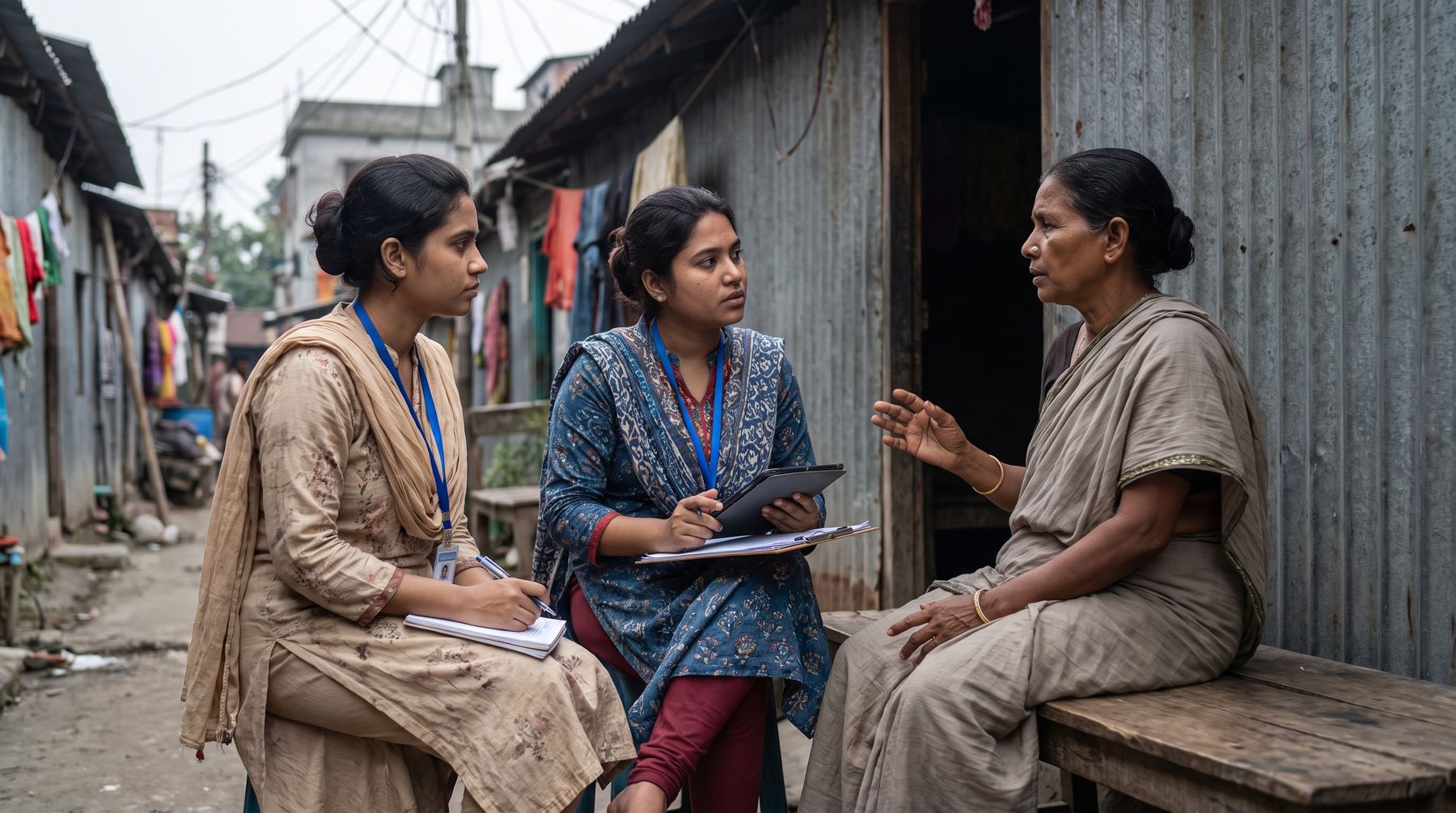
This role moves with the camp calendar. Ahead of a camp you work with the local women's group and the union parishad to circulate the dates, recruit participants for focus group discussions and book a room they can reach. During camp week you handle the logistics that decide whether the day works: consumables, seating, the queue, the referral slips, and the register that lets us trace who came back the following quarter.

Be clear about what this involves before applying. The work is physically demanding — long days on your feet, early starts, road travel over poor surfaces, and overnight stays in basic accommodation in field locations. Every member of a field team, including interns, completes a safeguarding briefing before travelling and works to the same reporting protocol; that briefing is a condition of joining a field trip, not a formality.

Role
Travelling to rural districts in Sylhet and Khulna to organise focus group discussions and support mobile health camp logistics.
Requirements
Undergraduate in Social Work or Sociology; comfortable with extensive travel and overnight stays in field locations.
Location
Field-based across Bangladesh.
Commitment
3 month cycles tied to the camp calendar.
Sylhet Khulna Focus groups Camp logistics Fieldwork
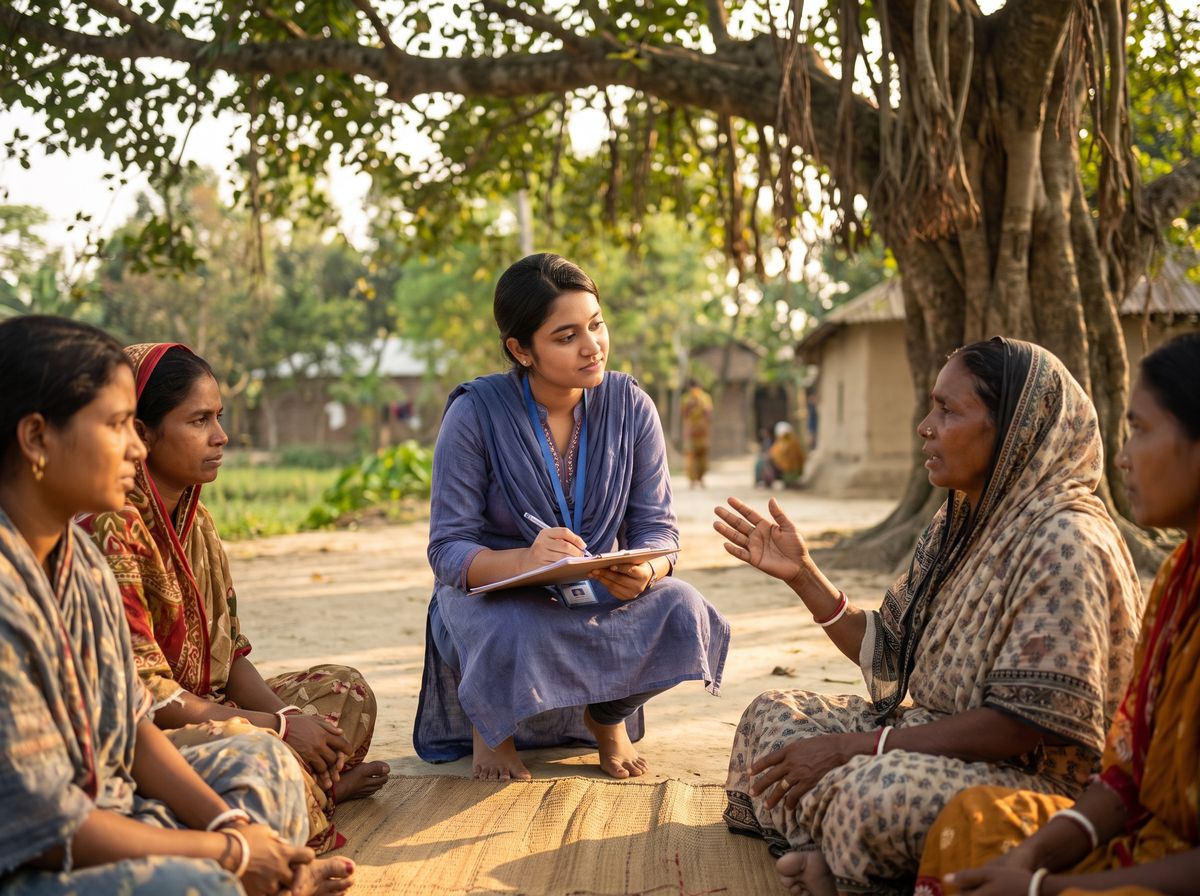
A young female research intern crouching beside rural women seated on a mat, taking notes during a discussion
Taking notes during a focus group discussion in a village courtyard.

The core of this role is translation of a different kind: taking a survey table that means something to a statistician and turning it into two pages a district health officer will read before a budget meeting. You draft policy briefs from findings the research team has already cleared, write and schedule posts across the organisation's social channels, and help assemble the quarterly donor reports — pulling programme figures together, checking them against the source, and drafting the narrative around them.

Everything you draft is reviewed before it is published, and any figure that appears in a brief or a post has to be traceable to a specific programme record. Where a number cannot be evidenced, we leave it out rather than round it into something quotable.

Role
Drafting policy briefs from survey findings, managing the organisation's social channels, and helping assemble donor reports.
Requirements
Excellent written English; familiarity with Canva or WordPress is useful but not required.
Location
Remote or Dhaka.
Commitment
Around 15 hours a week for 4 months.
Policy briefs Writing Donor reporting Social media
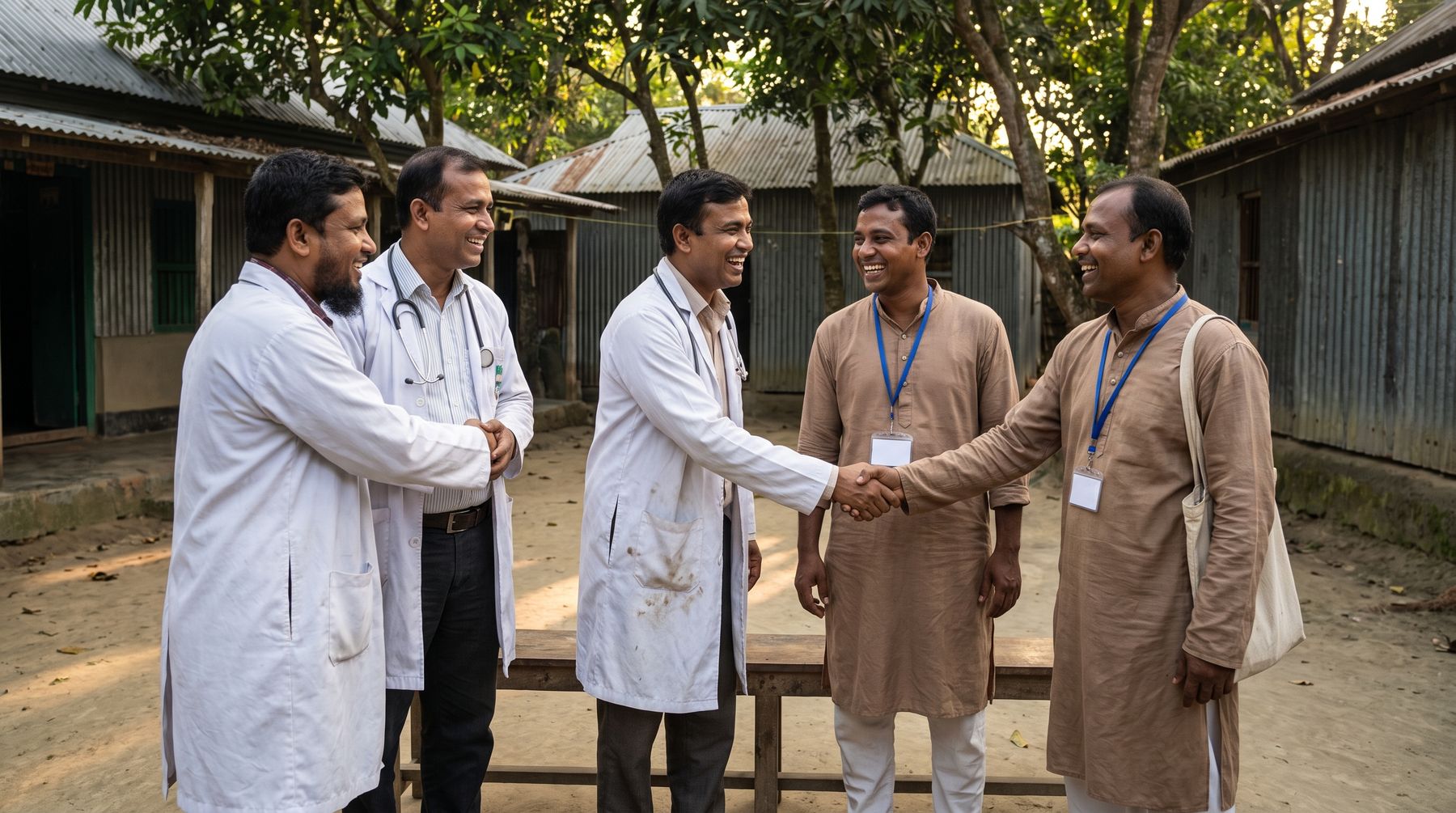
Srijoni Foundation staff meeting partner clinicians outside a local clinic in Bangladesh
Programme relationships supply the material that policy briefs are built from.

Apply

How an application is read, and by whom.

One application per person. Choose the role you want on the form, attach your CV, and use the final box to tell us why that particular role. A short, specific paragraph about what you want to learn is worth more to us than a long statement of general enthusiasm, and we would rather read about a module you found difficult than a list of adjectives.

Applications go to the programme lead for the role you selected. If your application is stronger for a role other than the one you chose, we will say so and ask whether you would like to be considered for it instead; we never move an application between roles without asking you first.

What happens after you submit

  • An automatic acknowledgement, so you know the file arrived.
  • A first read by the programme lead against the requirements listed for that role.
  • If shortlisted, a conversation of about thirty minutes, on WhatsApp video or in the Dhaka office, whichever suits you.
  • A written outcome either way. If we are not taking your application forward, we will say so rather than leave you waiting.

Applications are read on a rolling basis rather than held until a closing date, so an early application is read early.

Response times

Shortlisted candidates are contacted on WhatsApp within seven working days.

If the form will not upload your CV, email it to careers@srijonifoundation.org with the role in the subject line.

Submit your application

One application per person. Tell us which role you want and why.

A short paragraph is enough. We read every one.

Shortlisted candidates will be contacted via WhatsApp within 7 working days. Your CV and contact details are used only for this application and are deleted from our recruitment folder twelve months after the round closes.

Before you apply

How we recruit, and what we will never ask you for.

Every role is open to applicants regardless of gender, religion, ethnicity, disability or economic background, and applications are assessed against the requirements printed on this page and nothing else. Every field role includes a safeguarding briefing before travel, and every team member works to the same reporting protocol. We never ask an applicant for a fee, a deposit, or a payment of any kind at any stage — not for an application, an interview, training, or travel. If anyone claiming to represent Srijoni Foundation asks you for money, it is not us, and we would like to hear about it.

Latest
Srijoni Foundation presented its findings at the UN Women's Conference in Geneva. Swasthya Kendra mobile camps reach three new upazilas in Khulna division. Registration open for the 2026 Reproductive Health Index survey. Apon Jononi helpline extends counselling hours to six days a week.
Chat with our Research Team Monday–Friday, 9:00 AM – 5:00 PM (BST). Questions about the survey, our clinics or partnerships. Start a WhatsApp chat